Early this year, ground may finally be broken on the new home of Peninsula Golf Club.
The financially struggling club has been hoping to make a fresh start for more than three years, in large part because it can’t afford to make desperately needed improvements to its 55-year-old facility in Orewa, a coastal city roughly 25 miles north of Auckland.
Barring any further delays, by sometime in late 2014 or early 2015 the club will move to a nearby 200-acre location that features a 27-hole complex, a practice center, and a modern clubhouse, not to mention an extra sweetener: $10 million in spending money.
Moving day can’t come soon enough for most of Peninsula’s members. Today their club has fewer members than it did in 2007, and they’ve grown weary of the flooding issues that prevent them from playing on their course for up to three weeks a year. Both the course and the clubhouse need multimillion-dollar makeovers.
Peninsula’s new complex, consisting of an 18-hole regulation-length course and a nine-hole track for children and beginners, is being designed by Puddicombe Golf, a firm based in Alberta, Canada. Grant Puddicombe, the firm’s managing director, will oversee the construction.
Puddicombe Golf, which was established by Sid Puddicombe, has designed courses in four Canadian provinces but does most of its work in Alberta, where it’s produced such properties as RedTail Landing in Edmonton, WhiteTail Crossing in Mundare, and Coal Creek in Ryley. The firm rarely works in foreign countries, but it’s nonetheless established a presence in New Zealand, where it’s worked (or is currently working) on renovations with at least a half-dozen clubs.
The cost of Peninsula’s relocation is being covered by PLDL, Ltd., which plans to build 500 to 600 houses on Peninsula’s current 110-acre property.
The original version of the preceding post first appeared in the November 2012 issue of the World Edition of the Golf Course Report.
Wednesday, January 23, 2013

Sunday, January 20, 2013
The Week That Was, january 20, 2013
The North Sea has claimed part of Donald Trump’s golf course in Aberdeenshire, Scotland. The fierce storms battering the Scottish coast in recent weeks have weakened the dunes near the course’s fourth hole, causing part of a walking path to collapse. Some local residents who resent Trump are feeling positively gleeful about the incident -- in a

conversation with the Daily Mail, one of them called it “beautifully ironic” -- but a spokesperson for Trump believes the damage will be “easy to correct.” I don’t know whether that’s true or not. What I do know is that the sands on links courses shift constantly, which is why dunes need to be “stabilized” during golf construction. Heck, when the spring storms arrive in northeastern Scotland, such mini-landslides may very well occur on parts of another hole. It goes with the territory. The dunes occasionally slip away. “We’re delighted with how the course stood up to these extreme weather conditions,” the spokesperson said in comments published by the Scotsman. The course, which is currently closed for the winter, is expected to reopen in April, as scheduled.
Officials of some British golf clubs fear that the recent liquidation of Allerthorpe Park Golf Club, in East Yorkshire, England, may be a harbinger of further closings in the immediate future. “I would not be surprised to see one or two more,” said the general manager of Fulford Golf Club. “There’s a lot of problems in the golf industry.” The biggest problem, of course, is an old bugaboo: Supply is greater than demand. In addition, the York Press says, golf clubs in York and North Yorkshire have struggled of late with “the ravages of a depressed economy” and “a summer and winter where the weather has severely blighted vital income.”
Jiro may dream of sushi, but PGM Holdings no longer dreams of becoming Japan’s biggest golf-management company. PGM has abandoned its attempt to acquire a controlling interest in Accordia Golf Company, which currently operates 132 golf properties, as it couldn’t acquire enough of Accordia’s stock. Bloomberg reports that the takeover attempt has been a coup for Accordia’s shareholders, since the price of the company’s stock has increased by more than 50 percent since mid November, when the battle began. What’s more, in an effort to hold onto its stockholders, Accordia has reportedly more than tripled the amount of the dividend it had originally planned to pay.
Superstorm Sandy has claimed one more victim: Middle Bay Golf Club in Oceanside, New York. The club, which features an Alfred Tull-designed course that opened in the mid 1950s, is located along the southern coast of Long Island, in an area that was devastated by the storm. To revive itself, Middle Bay needed to cover an estimated $3.5 million in damages, but it simply couldn’t summon the will to do so, especially after it lost about one-third of its 230 members. “They were as badly hit by the storm as the club was,” the club’s general manager told Newsday. “A lot of our members living in the area haven’t even been able to go back to their own homes yet.”
It’s way too early to call this a trend, but a posh golf club in Florida is bragging about the number of new members it attracted last year. Concession Golf Club in Bradenton, which reportedly has an initiation fee of $125,000 (plus $11,500 in annual dues), signed “about 50” new members in 2012, bringing its total membership to 165. (Reality check: That’s barely half of where the club eventually hopes to be.) The Sarasota Herald-Tribune also notes that Founders Golf Club in Sarasota boosted its membership by 15 percent last year (to a record high of 228), although its memberships cost only $17,500. The newspaper, which believes that “upscale club membership represents a unique barometer of the region’s overall fiscal health,” concludes that the clubs have grown because they “trimmed the cost of dues, expanded the types of memberships, and crafted more social and casual activities.”
An unexpectedly large rent increase may threaten the future of Magdalene Fields, the northernmost golf club in England. Since 1996, the Berwick-based club has paid an annual fee of £8,500 (about $13,500) to Northumberland County, but this year the county wants to boost the amount to £18,000 (about $28,500) -- an increase of 118 percent, according to the Berwick Advertiser. “We’re simply not the sort of golf club which has that sort of money,” the club’s secretary told the newspaper. In fact, the club reportedly lost £19,000 (more than $30,000) in 2012, in part because rainy weather forced it to close 18 times. The club, which was established in 1903, is said to be exploring its legal options.
The Wisconsin section of the PGA has exacted a little revenge on the city of Madison. For the past 22 years, the group’s annual junior championship has been held at Yahara Hills Golf Course in Madison. But this year, in a major departure from tradition, the event will be played at a county-owned golf course in Milwaukee. Why the switch? Because last year Madison decided not to renew the contracts of the four PGA pros who ran its golf courses.
It turns out that Tom Doak may not design the forthcoming 2.5-acre putting course at Bandon Dunes. Bandon Western World says that Doak has been hired to create the course, but the oceanfront golf venue in Oregon is also considering Jim Urbina, one of Doak’s former associates, for the job. “At this point we’re not sure about the designer,” a spokesperson for Bandon Dunes said in a telephone message. “It could be Doak or Urbina. There are still a lot of hoops that need to be jumped through before we start moving dirt.” In either case, Mike Keiser, the resort's owner, still expects construction to begin sometime this year or next.
These days, the members of Royal Sydney Golf Club don’t want anyone to have a blast on their golf course. A recently published military history claims that an unexploded artillery shell is lurking somewhere beneath the eighth fairway of the club’s Centenary course. The book’s author doesn’t think the shell will explode anytime soon -- it was fired by a Japanese submarine during World War II -- but he counseled that “if they ever reclaimed the land and builders started to put in high-density housing, then I wouldn’t want to be around.”
I need to make a correction. Two Sundays ago, I reported that the government of Singapore’s investment arm had agreed to buy four golf properties from Paulson & Company. I correctly identified two of the properties -- PGA West in La Quinta, California and the Great White course at Doral Golf Resort in Miami, Florida -- but was wrong about the others. The sale will include two other properties in La Quinta: La Quinta Resort & Club (two 18-hole courses) and Cirtus Club at La Quinta (one 18-hole course). Yes, Singapore is buying the Arizona Biltmore Resort & Spa in Phoenix and the Grand Wailea Resort Hotel & Spa on Maui in Hawaii, but its purchase doesn’t include the resorts’ golf courses. I apologize for the error.
There are no boa constructors or guillotines, but last week the always entertaining Alice Cooper told the Los Angeles Times why he took up golf (“I had to find an addiction that was not going to kill me”), reveled in the pleasures of playing courses that are usually off-limits to goth-rockers (“They can’t keep me off, because in most cases I’m better than the guy who wants to keep me off”), and made a case for golf being the ultimate democratic sport (“It doesn’t matter if you’re the president of the United States, a gardener, or a garbage man, if you can help a guy hit the ball straight, all bets are off about who you are or what you do”). Cooper admits that his game is on the decline, but he seems to be content with the way his life turned out. When it comes to careers, he noted, “I would much rather be a rock singer than a golfer.”

conversation with the Daily Mail, one of them called it “beautifully ironic” -- but a spokesperson for Trump believes the damage will be “easy to correct.” I don’t know whether that’s true or not. What I do know is that the sands on links courses shift constantly, which is why dunes need to be “stabilized” during golf construction. Heck, when the spring storms arrive in northeastern Scotland, such mini-landslides may very well occur on parts of another hole. It goes with the territory. The dunes occasionally slip away. “We’re delighted with how the course stood up to these extreme weather conditions,” the spokesperson said in comments published by the Scotsman. The course, which is currently closed for the winter, is expected to reopen in April, as scheduled.
Officials of some British golf clubs fear that the recent liquidation of Allerthorpe Park Golf Club, in East Yorkshire, England, may be a harbinger of further closings in the immediate future. “I would not be surprised to see one or two more,” said the general manager of Fulford Golf Club. “There’s a lot of problems in the golf industry.” The biggest problem, of course, is an old bugaboo: Supply is greater than demand. In addition, the York Press says, golf clubs in York and North Yorkshire have struggled of late with “the ravages of a depressed economy” and “a summer and winter where the weather has severely blighted vital income.”
Jiro may dream of sushi, but PGM Holdings no longer dreams of becoming Japan’s biggest golf-management company. PGM has abandoned its attempt to acquire a controlling interest in Accordia Golf Company, which currently operates 132 golf properties, as it couldn’t acquire enough of Accordia’s stock. Bloomberg reports that the takeover attempt has been a coup for Accordia’s shareholders, since the price of the company’s stock has increased by more than 50 percent since mid November, when the battle began. What’s more, in an effort to hold onto its stockholders, Accordia has reportedly more than tripled the amount of the dividend it had originally planned to pay.
Superstorm Sandy has claimed one more victim: Middle Bay Golf Club in Oceanside, New York. The club, which features an Alfred Tull-designed course that opened in the mid 1950s, is located along the southern coast of Long Island, in an area that was devastated by the storm. To revive itself, Middle Bay needed to cover an estimated $3.5 million in damages, but it simply couldn’t summon the will to do so, especially after it lost about one-third of its 230 members. “They were as badly hit by the storm as the club was,” the club’s general manager told Newsday. “A lot of our members living in the area haven’t even been able to go back to their own homes yet.”
It’s way too early to call this a trend, but a posh golf club in Florida is bragging about the number of new members it attracted last year. Concession Golf Club in Bradenton, which reportedly has an initiation fee of $125,000 (plus $11,500 in annual dues), signed “about 50” new members in 2012, bringing its total membership to 165. (Reality check: That’s barely half of where the club eventually hopes to be.) The Sarasota Herald-Tribune also notes that Founders Golf Club in Sarasota boosted its membership by 15 percent last year (to a record high of 228), although its memberships cost only $17,500. The newspaper, which believes that “upscale club membership represents a unique barometer of the region’s overall fiscal health,” concludes that the clubs have grown because they “trimmed the cost of dues, expanded the types of memberships, and crafted more social and casual activities.”
An unexpectedly large rent increase may threaten the future of Magdalene Fields, the northernmost golf club in England. Since 1996, the Berwick-based club has paid an annual fee of £8,500 (about $13,500) to Northumberland County, but this year the county wants to boost the amount to £18,000 (about $28,500) -- an increase of 118 percent, according to the Berwick Advertiser. “We’re simply not the sort of golf club which has that sort of money,” the club’s secretary told the newspaper. In fact, the club reportedly lost £19,000 (more than $30,000) in 2012, in part because rainy weather forced it to close 18 times. The club, which was established in 1903, is said to be exploring its legal options.
The Wisconsin section of the PGA has exacted a little revenge on the city of Madison. For the past 22 years, the group’s annual junior championship has been held at Yahara Hills Golf Course in Madison. But this year, in a major departure from tradition, the event will be played at a county-owned golf course in Milwaukee. Why the switch? Because last year Madison decided not to renew the contracts of the four PGA pros who ran its golf courses.
It turns out that Tom Doak may not design the forthcoming 2.5-acre putting course at Bandon Dunes. Bandon Western World says that Doak has been hired to create the course, but the oceanfront golf venue in Oregon is also considering Jim Urbina, one of Doak’s former associates, for the job. “At this point we’re not sure about the designer,” a spokesperson for Bandon Dunes said in a telephone message. “It could be Doak or Urbina. There are still a lot of hoops that need to be jumped through before we start moving dirt.” In either case, Mike Keiser, the resort's owner, still expects construction to begin sometime this year or next.
These days, the members of Royal Sydney Golf Club don’t want anyone to have a blast on their golf course. A recently published military history claims that an unexploded artillery shell is lurking somewhere beneath the eighth fairway of the club’s Centenary course. The book’s author doesn’t think the shell will explode anytime soon -- it was fired by a Japanese submarine during World War II -- but he counseled that “if they ever reclaimed the land and builders started to put in high-density housing, then I wouldn’t want to be around.”
I need to make a correction. Two Sundays ago, I reported that the government of Singapore’s investment arm had agreed to buy four golf properties from Paulson & Company. I correctly identified two of the properties -- PGA West in La Quinta, California and the Great White course at Doral Golf Resort in Miami, Florida -- but was wrong about the others. The sale will include two other properties in La Quinta: La Quinta Resort & Club (two 18-hole courses) and Cirtus Club at La Quinta (one 18-hole course). Yes, Singapore is buying the Arizona Biltmore Resort & Spa in Phoenix and the Grand Wailea Resort Hotel & Spa on Maui in Hawaii, but its purchase doesn’t include the resorts’ golf courses. I apologize for the error.
There are no boa constructors or guillotines, but last week the always entertaining Alice Cooper told the Los Angeles Times why he took up golf (“I had to find an addiction that was not going to kill me”), reveled in the pleasures of playing courses that are usually off-limits to goth-rockers (“They can’t keep me off, because in most cases I’m better than the guy who wants to keep me off”), and made a case for golf being the ultimate democratic sport (“It doesn’t matter if you’re the president of the United States, a gardener, or a garbage man, if you can help a guy hit the ball straight, all bets are off about who you are or what you do”). Cooper admits that his game is on the decline, but he seems to be content with the way his life turned out. When it comes to careers, he noted, “I would much rather be a rock singer than a golfer.”
Friday, January 18, 2013
The Pipeline, january 18, 2013
A recently retired London-based hedge-fund manager has hired Bob Harrison to design a links course on a small island in the Inner Hebrides. Greg Coffey aims to build the course on a coastal slice of his 11,668-acre Ardfin Estate, which lies along the southeastern coast of Scotland’s Jura Island. Harrison isn’t well known in the United States, but he spent the better part of two decades serving as the “ghost” architect in Greg Norman’s Australian practice and is largely responsible for its best work. Last year, he called Jura “my favorite place on earth” and said the site he’s been given is “the most beautiful I have ever seen.” It’s easy to understand why Harrison is so excited, as Coffey's commission offers him a chance to become internationally known, in a league with minimalists such as Tom Doak or Coore & Crenshaw. Only one problem: The track will serve as Coffey’s personal course, which means that it won’t get the sizzle that accrues from being named to best-of lists.
Some information in this post originally appeared in the August and September 2012 issues of the World Edition of the Golf Course Report.
Local officials in Tasmania have endorsed Greg Ramsay’s proposal to build a destination-worthy golf course on 365 acres of government-owned property on the South Arm peninsula, along the island’s southern coast. Ramsay, the golf guru and tourism promoter who conceived Barnbougle Dunes, hopes to break ground on the layout by the end of this year, presuming that he can secure the remaining approvals he needs. Ramsay hasn’t offered any details about what he aims to build on South Arm, but he’s working with a crew of designers who have minimalist sympathies: Mike Nuzzo, Line Mortensen, and the team of Neil Crafter and Paul Mogford. Unlike the land at Barnbougle Dunes, the land on the peninsula doesn’t appear to be made-to-order for golf, seeing as how last year Ramsay told the Hobart Mercury that his proposal offers “a wonderful opportunity for re-vegetating a degraded site back to great beauty.” Degraded site or not, if Ramsay builds it, they will come.
Some information in this post originally appeared in the April and October 2012 issues of the World Edition of the Golf Course Report.
The first nine holes of a 27-hole golf complex northeast of Mianyang, in China’s Sichuan Province, could be open for play before the end of the year. The complex, which has been designed by Phil Ryan, an Australian architect, will be the featured attraction of a 940-acre resort community that’s taking shape near Chenkangtun Reservoir. A press release says the lake is “beautiful” and the site of the golf course “spectacular.” It doesn’t say when Chengdu Hongyuan Investment Company, Ltd. plans to open the other nines, but it notes that they’ll each stretch to roughly 3,700 yards.
Colin Montgomerie will put his “signature” on the first “international-standard” golf course in Goa, the Indian state made famous by wandering hippies in the 1960s. The track will be the featured attraction of a to-be-named resort that will take shape on 301 acres outside Pernem, along Goa’s border with Maharashtra. The property, which will include a cluster of villas, a Four Seasons hotel, and a spa, is being developed by New Delhi-based Leading Hotels, Ltd. and Mumbai-based Magus Hotels. The golf course is being co-designed by Brit Stenson, who operates out of IMG’s office in Cleveland, Ohio. Mark Adams of IMG’s office in Singapore recently told me that the firm has been given “one of the best sites we have seen in Asia,” and he believes the final result will be “the best golf course in India.” Construction is expected to begin next year.
Some information in this post originally appeared in the November 2012 issue of the World Edition of the Golf Course Report.
David McLay Kidd’s new golf course in Nicaragua will soon have some competition. A travel writer reports that the first nine holes of a planned 18-hole track at Montecristo Lifestyle Estates is expected to open this summer. Mike Young, an architect based in Athens, Georgia, has designed a 7,060-yard “core” track for the community, which is said to be taking shape on 2,000 acres along the nation’s Pacific coast, the Costa Azul, about 40 miles west of Managua. “The golf course,” Young says, “is going to not only introduce a new way of life to this culture but also offer numerous opportunities to people here that don’t necessarily exist today.” No word on when the second nine opens, but the entire 18-hole layout was originally supposed to open in 2008.
Some information in this post originally appeared in the September 2011 issue of the World Edition of the Golf Course Report.
Mike Keiser, the majority owner of the Bandon Dunes resort, may soon be able to offer the world’s golfers yet another reason to visit Oregon’s windswept Pacific coast. Keiser thinks he can break ground on his long-planned “municipal” golf complex in 2014, seeing as how he’s getting closer to wrapping up the land swap that he’s been negotiating for years. “This will be all about the local players, especially juniors,” Keiser told a local newspaper. Of course, there’s one other nagging detail that may gum up the construction schedule: Gil Hanse, the complex’s designer, is going to be preoccupied in Brazil for the next 12 to 18 months.
Only Slightly Off Topic
No doubt, you’ve already heard that 2012 was the hottest year ever in the contiguous United States. But lately, unusually severe weather-related events have been taking place all over the planet. When it comes to weather, says the New York Times, “extreme has become the new commonplace.” The Times has catalogued some of the strangeness: In Australia, where every decade since the 1950s has been hotter than the one that preceded it, bush fires are raging. In England, 2012 has gone down as the wettest year since record-keeping began more than 100 years ago. In Siberia, where temperatures have dipped as low as 50 degrees below zero, transportation officials had to cancel bus service between cities out of fear that breakdowns could lead to deaths from exposure to extreme cold. In Brazil, where a “punishingly hot” summer has evaporated reservoirs, energy analysts worry that they may need to ration electricity for the first time since 2002. “Each year we have extreme weather, but it’s unusual to have so many extreme events around the world at once,” an official of the World Meteorological Organization told the newspaper. Such weather extremes can’t be ignored. It’s only a matter of time before we begin to measure their impact on the golf business.
Some information in this post originally appeared in the August and September 2012 issues of the World Edition of the Golf Course Report.
Local officials in Tasmania have endorsed Greg Ramsay’s proposal to build a destination-worthy golf course on 365 acres of government-owned property on the South Arm peninsula, along the island’s southern coast. Ramsay, the golf guru and tourism promoter who conceived Barnbougle Dunes, hopes to break ground on the layout by the end of this year, presuming that he can secure the remaining approvals he needs. Ramsay hasn’t offered any details about what he aims to build on South Arm, but he’s working with a crew of designers who have minimalist sympathies: Mike Nuzzo, Line Mortensen, and the team of Neil Crafter and Paul Mogford. Unlike the land at Barnbougle Dunes, the land on the peninsula doesn’t appear to be made-to-order for golf, seeing as how last year Ramsay told the Hobart Mercury that his proposal offers “a wonderful opportunity for re-vegetating a degraded site back to great beauty.” Degraded site or not, if Ramsay builds it, they will come.
Some information in this post originally appeared in the April and October 2012 issues of the World Edition of the Golf Course Report.
The first nine holes of a 27-hole golf complex northeast of Mianyang, in China’s Sichuan Province, could be open for play before the end of the year. The complex, which has been designed by Phil Ryan, an Australian architect, will be the featured attraction of a 940-acre resort community that’s taking shape near Chenkangtun Reservoir. A press release says the lake is “beautiful” and the site of the golf course “spectacular.” It doesn’t say when Chengdu Hongyuan Investment Company, Ltd. plans to open the other nines, but it notes that they’ll each stretch to roughly 3,700 yards.
Colin Montgomerie will put his “signature” on the first “international-standard” golf course in Goa, the Indian state made famous by wandering hippies in the 1960s. The track will be the featured attraction of a to-be-named resort that will take shape on 301 acres outside Pernem, along Goa’s border with Maharashtra. The property, which will include a cluster of villas, a Four Seasons hotel, and a spa, is being developed by New Delhi-based Leading Hotels, Ltd. and Mumbai-based Magus Hotels. The golf course is being co-designed by Brit Stenson, who operates out of IMG’s office in Cleveland, Ohio. Mark Adams of IMG’s office in Singapore recently told me that the firm has been given “one of the best sites we have seen in Asia,” and he believes the final result will be “the best golf course in India.” Construction is expected to begin next year.
Some information in this post originally appeared in the November 2012 issue of the World Edition of the Golf Course Report.
David McLay Kidd’s new golf course in Nicaragua will soon have some competition. A travel writer reports that the first nine holes of a planned 18-hole track at Montecristo Lifestyle Estates is expected to open this summer. Mike Young, an architect based in Athens, Georgia, has designed a 7,060-yard “core” track for the community, which is said to be taking shape on 2,000 acres along the nation’s Pacific coast, the Costa Azul, about 40 miles west of Managua. “The golf course,” Young says, “is going to not only introduce a new way of life to this culture but also offer numerous opportunities to people here that don’t necessarily exist today.” No word on when the second nine opens, but the entire 18-hole layout was originally supposed to open in 2008.
Some information in this post originally appeared in the September 2011 issue of the World Edition of the Golf Course Report.
Mike Keiser, the majority owner of the Bandon Dunes resort, may soon be able to offer the world’s golfers yet another reason to visit Oregon’s windswept Pacific coast. Keiser thinks he can break ground on his long-planned “municipal” golf complex in 2014, seeing as how he’s getting closer to wrapping up the land swap that he’s been negotiating for years. “This will be all about the local players, especially juniors,” Keiser told a local newspaper. Of course, there’s one other nagging detail that may gum up the construction schedule: Gil Hanse, the complex’s designer, is going to be preoccupied in Brazil for the next 12 to 18 months.
Only Slightly Off Topic
No doubt, you’ve already heard that 2012 was the hottest year ever in the contiguous United States. But lately, unusually severe weather-related events have been taking place all over the planet. When it comes to weather, says the New York Times, “extreme has become the new commonplace.” The Times has catalogued some of the strangeness: In Australia, where every decade since the 1950s has been hotter than the one that preceded it, bush fires are raging. In England, 2012 has gone down as the wettest year since record-keeping began more than 100 years ago. In Siberia, where temperatures have dipped as low as 50 degrees below zero, transportation officials had to cancel bus service between cities out of fear that breakdowns could lead to deaths from exposure to extreme cold. In Brazil, where a “punishingly hot” summer has evaporated reservoirs, energy analysts worry that they may need to ration electricity for the first time since 2002. “Each year we have extreme weather, but it’s unusual to have so many extreme events around the world at once,” an official of the World Meteorological Organization told the newspaper. Such weather extremes can’t be ignored. It’s only a matter of time before we begin to measure their impact on the golf business.
Wednesday, January 16, 2013
india Faldo Notches a Mega-Project
The age of “signature” golf architecture hasn’t yet fully arrived in India. But Nick Faldo is doing his best to open the door for it.
Faldo has been commissioned to design an 18-hole, “championship-standard” track for Sushant Megapolis, a 2,504-acre planned community that’s to be built in Greater Noida, the fast-growing, corporation-fueled satellite city outside New Delhi. The commission is the former British golf pro’s second in India, as his firm has also been slated to produce an 18-hole course for the Lavasa resort community in metropolitan Pune, in the state of Maharashtra.

Sushant Megapolis is a high-profile venture that will serve as a big stage for Faldo’s work. It’s been master-planned to include a slew of houses, a biotechnology park, an “education zone” with schools for children of all ages, a “medicity” with “highly skilled and specialized doctors,” a sports academy with an equestrian center and polo fields, a handful of lakes and musical fountains, and a tennis academy branded by Mahesh Bhupathi, a Wimbledon doubles champion.
The community’s developer, New Delhi-based Ansal Properties & Infrastructure, Ltd., calls the place “an employment-oriented, self-sustaining town of the future” and “a perfect blend of nature’s glory, modern infrastructure, elegance, and luxury.” If sales take off, the community can grow to 9,000 acres.
API is developing a nearly identical community, Sushant Golf City, in Lucknow, the capital of Uttar Pradesh. The community will eventually feature an 18-hole course that’s been designed by Martin Hawtree, the third-generation British architect who created Donald Trump’s golf course in Aberdeenshire, Scotland. Last year Pranav Ansal, API’s managing director, told an Indian construction journal that the course’s first nine holes have been opened.
As for Faldo’s course outside Pune, it appears to be stuck in development mud. Faldo, who’s based in Windsor, England, got the commission in 2009 and has yet to break ground on the planned 18-hole course and Faldo-branded golf academy.
Faldo is likewise waiting for API to set a construction schedule for the course at Sushant Megapolis. One of his associates recently told me that the firm is under contract but “awaiting further instruction.” That could explain why news of the commission hasn’t yet been posted on Faldo’s website.
The original version of the preceding post first appeared in the October 2012 issue of the World Edition of the Golf Course Report.
Faldo has been commissioned to design an 18-hole, “championship-standard” track for Sushant Megapolis, a 2,504-acre planned community that’s to be built in Greater Noida, the fast-growing, corporation-fueled satellite city outside New Delhi. The commission is the former British golf pro’s second in India, as his firm has also been slated to produce an 18-hole course for the Lavasa resort community in metropolitan Pune, in the state of Maharashtra.

Sushant Megapolis is a high-profile venture that will serve as a big stage for Faldo’s work. It’s been master-planned to include a slew of houses, a biotechnology park, an “education zone” with schools for children of all ages, a “medicity” with “highly skilled and specialized doctors,” a sports academy with an equestrian center and polo fields, a handful of lakes and musical fountains, and a tennis academy branded by Mahesh Bhupathi, a Wimbledon doubles champion.
The community’s developer, New Delhi-based Ansal Properties & Infrastructure, Ltd., calls the place “an employment-oriented, self-sustaining town of the future” and “a perfect blend of nature’s glory, modern infrastructure, elegance, and luxury.” If sales take off, the community can grow to 9,000 acres.
API is developing a nearly identical community, Sushant Golf City, in Lucknow, the capital of Uttar Pradesh. The community will eventually feature an 18-hole course that’s been designed by Martin Hawtree, the third-generation British architect who created Donald Trump’s golf course in Aberdeenshire, Scotland. Last year Pranav Ansal, API’s managing director, told an Indian construction journal that the course’s first nine holes have been opened.
As for Faldo’s course outside Pune, it appears to be stuck in development mud. Faldo, who’s based in Windsor, England, got the commission in 2009 and has yet to break ground on the planned 18-hole course and Faldo-branded golf academy.
Faldo is likewise waiting for API to set a construction schedule for the course at Sushant Megapolis. One of his associates recently told me that the firm is under contract but “awaiting further instruction.” That could explain why news of the commission hasn’t yet been posted on Faldo’s website.
The original version of the preceding post first appeared in the October 2012 issue of the World Edition of the Golf Course Report.
Sunday, January 13, 2013
The Week That Was, january 13, 2013
It didn’t take long for the city of Dallas, Texas and its development partners to settle on a designer for their new golf course. The commission for the recently announced Trinity Forest Golf Course has gone to Bill Coore and Ben Crenshaw, the hottest design team on the

planet. The partners made their reputation by fashioning “naturalist” layouts -- Sand Hills Golf Club in Nebraska, the Lost Farm track at Barnbougle Dunes in Tasmania, the Trails course at Bandon Dunes -- but they’re going in a distinctly different direction this time, as the property they’ll be working with in Dallas is a landfill. That being said, Coore thinks the site has “great character,” is “inherently appealing for classic golf,” and has “the potential to yield an outstanding golf course.” I don’t know about you, but I’m wondering about the fee that Coore and Crenshaw have negotiated. As I reported just three weeks ago, an official from AT&T, one of the venture’s sponsors, has said that the course’s architect will be paid only enough to “cover their time and costs and nothing else.”
Borrowing ideas from St. Andrews in Scotland and the Pinehurst resort in North Carolina, Mike Keiser has conceived the next attraction for Bandon Dunes: A putting course that will occupy nearly 2.5 acres at the famed oceanfront golf venue in Oregon. “It will be the eighth wonder of golf,” Keiser told a local newspaper. The layout will be designed by Tom Doak, who’s already produced two of Bandon Dunes’ courses, and Keiser expects construction to begin sometime this year or next.
The hottest development controversy in golf these days has ignited passions in County Antrim, in Northern Ireland. Government officials have endorsed a plan to build Bushmills Dunes, a 356-acre resort that will include a David McLay Kidd-designed golf course, but the National Trust, one of the U.K.’s biggest and best-funded historic preservation groups, has lodged a legal challenge that it hopes will thwart the development. Alistair Hanna, the New York City-based developer of Bushmills Dunes, contends that the golf course -- Kidd has guaranteed that it’ll rank among the world’s top 50 -- will make Northern Ireland the “gold standard” in links golf and create hundreds of jobs in a place that could desperately use them. The trust fears that the resort will have an unfavorable impact on Giant’s Causeway, a popular tourist destination and Northern Ireland’s only Unesco world heritage site. The Guardian says that the battle “could become a defining event for Northern Ireland” that “will have consequences not just for the causeway but, potentially, for the U.K.’s other 27 Unesco-listed sites.” A year or so ago, Mike Keiser was thinking about investing in Bushmills Dunes, but he likely won’t make any commitments until the heat dies down.
Some information in the preceding post originally appeared in the October 2011 and June 2012 issues of the World Edition of the Golf Course Report.
Speaking of David McLay Kidd, his forthcoming golf course in Leatherhead, England is also going through a tough slog these days. Longshot, Ltd., the developer, has secured local approvals for the 370-acre Cherkley Court project and has withstood a subsequent appeal, but a group of environmentalists has persuaded higher officials to review the previous decisions. “It is in the public interest to mount a legal challenge,” a protester told the Epsom Guardian. Ollie Vigors, one of Longshot’s principals, has characterized the protesters as “a small minority of people who will stop at nothing to get our planning permission quashed with no grounds for doing so.” A year or so ago, Kidd told me that the golf course will be “very natural” and “ragged at the edges.” Longshot was hoping to break ground on it this month, but my guess is that the construction will be delayed.
Some information in the preceding post originally appeared in the December 2011 and September 2012 issues of the World Edition of the Golf Course Report.
Donald Trump has revealed his strategy for blocking the construction of an off-shore wind farm within view of his golf resort in Scotland: He’s going to “lawyer” his opponents into submission. Trump wants a public hearing on a green-energy proposal to build a group of wind turbines off the coast of Aberdeenshire, and he’s threatened to tie up the proceedings in court for a decade if government officials don’t agree to his demands. Citing his company’s “experience in legal matters,” last week one of Trump’s lieutenants warned that “we have the resources to hold this up for a very long time.” You’ve got to hand it to Trump: He really knows how to win friends and influence people.
In an attempt to attract younger members, Rancho Santa Fe Golf Club may allow prospects under the age of 48 to pay their $50,000 initiation fee in installments. “This is a market we’d like to go after,” the club’s general manager explained to the Rancho Santa Fe Review. The proposal has generated some debate, but newspaper says that the club, in suburban San Diego, California, is “losing members faster than they are gaining them.” One problem in particular: These days the club attracts only 17 percent of the families who move into the community, down from 30 percent in days gone by.
Rees Jones, the “Open Doctor,” has won this year’s Donald Ross Award, for his contributions to our business. “Rees’ influence in the golf industry is profound,” said Bob Cupp, the president of the American Society of Golf Course Architects. The ASGCA has been making the award since 1976, but only six architects have previously been winners. The group consists of Pete Dye, Jack Nicklaus, Arnold Palmer, Geoffrey Cornish, Mike Hurdzan, and Jones’ father, Robert Trent Jones.
Jay Blasi, an 11-year veteran at Robert Trent Jones, Jr.’s design firm, has hung out his own shingle. His new firm, according to a press release, will dedicate itself to “restoring, renovating, and creating timeless courses through a hands-on approach.” While working for Jones, Blasi made a name for himself by transforming a gravel pit in suburban Tacoma, Washington into Chambers Bay Golf Club. Links magazine called his work “one of the greatest debuts in golf history” and marveled over the layout’s bumpy terrain, saying that it was “meticulously crafted as to look as if swept by the wind.” While he awaits his first solo design commission, Blasi will be working on renovations of two courses not far from his office in Los Gatos.
David Gould of Fox News has tallied his eight favorite waterfront golf venues, presumably to entice people like you and me to play them. Don’t expect any real surprises. The group includes the Pacific Dunes track at Bandon Dunes in Oregon (“the ‘it’ golf course for people who know what’s up and are looking to avoid the status-conscious excess of other American courses”), the Plantation course at the Kapaula resort in Hawaii (“breeze-washed terrain that opens up to soul-stirring middle- and long-distance views of the endless Pacific”), the Ocean course on Kiawah Island in South Carolina (“stunning, daring, boldly featured, and nearly impossible to play”), and, of course, Pebble Beach Golf Links in California (“you can play golf the world over, but seldom will the sea treat you to as dramatic a performance”).
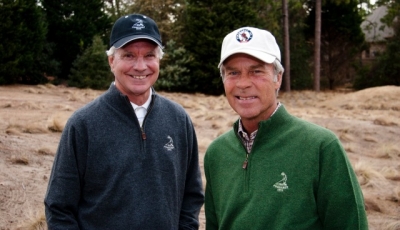
planet. The partners made their reputation by fashioning “naturalist” layouts -- Sand Hills Golf Club in Nebraska, the Lost Farm track at Barnbougle Dunes in Tasmania, the Trails course at Bandon Dunes -- but they’re going in a distinctly different direction this time, as the property they’ll be working with in Dallas is a landfill. That being said, Coore thinks the site has “great character,” is “inherently appealing for classic golf,” and has “the potential to yield an outstanding golf course.” I don’t know about you, but I’m wondering about the fee that Coore and Crenshaw have negotiated. As I reported just three weeks ago, an official from AT&T, one of the venture’s sponsors, has said that the course’s architect will be paid only enough to “cover their time and costs and nothing else.”
Borrowing ideas from St. Andrews in Scotland and the Pinehurst resort in North Carolina, Mike Keiser has conceived the next attraction for Bandon Dunes: A putting course that will occupy nearly 2.5 acres at the famed oceanfront golf venue in Oregon. “It will be the eighth wonder of golf,” Keiser told a local newspaper. The layout will be designed by Tom Doak, who’s already produced two of Bandon Dunes’ courses, and Keiser expects construction to begin sometime this year or next.
The hottest development controversy in golf these days has ignited passions in County Antrim, in Northern Ireland. Government officials have endorsed a plan to build Bushmills Dunes, a 356-acre resort that will include a David McLay Kidd-designed golf course, but the National Trust, one of the U.K.’s biggest and best-funded historic preservation groups, has lodged a legal challenge that it hopes will thwart the development. Alistair Hanna, the New York City-based developer of Bushmills Dunes, contends that the golf course -- Kidd has guaranteed that it’ll rank among the world’s top 50 -- will make Northern Ireland the “gold standard” in links golf and create hundreds of jobs in a place that could desperately use them. The trust fears that the resort will have an unfavorable impact on Giant’s Causeway, a popular tourist destination and Northern Ireland’s only Unesco world heritage site. The Guardian says that the battle “could become a defining event for Northern Ireland” that “will have consequences not just for the causeway but, potentially, for the U.K.’s other 27 Unesco-listed sites.” A year or so ago, Mike Keiser was thinking about investing in Bushmills Dunes, but he likely won’t make any commitments until the heat dies down.
Some information in the preceding post originally appeared in the October 2011 and June 2012 issues of the World Edition of the Golf Course Report.
Speaking of David McLay Kidd, his forthcoming golf course in Leatherhead, England is also going through a tough slog these days. Longshot, Ltd., the developer, has secured local approvals for the 370-acre Cherkley Court project and has withstood a subsequent appeal, but a group of environmentalists has persuaded higher officials to review the previous decisions. “It is in the public interest to mount a legal challenge,” a protester told the Epsom Guardian. Ollie Vigors, one of Longshot’s principals, has characterized the protesters as “a small minority of people who will stop at nothing to get our planning permission quashed with no grounds for doing so.” A year or so ago, Kidd told me that the golf course will be “very natural” and “ragged at the edges.” Longshot was hoping to break ground on it this month, but my guess is that the construction will be delayed.
Some information in the preceding post originally appeared in the December 2011 and September 2012 issues of the World Edition of the Golf Course Report.
Donald Trump has revealed his strategy for blocking the construction of an off-shore wind farm within view of his golf resort in Scotland: He’s going to “lawyer” his opponents into submission. Trump wants a public hearing on a green-energy proposal to build a group of wind turbines off the coast of Aberdeenshire, and he’s threatened to tie up the proceedings in court for a decade if government officials don’t agree to his demands. Citing his company’s “experience in legal matters,” last week one of Trump’s lieutenants warned that “we have the resources to hold this up for a very long time.” You’ve got to hand it to Trump: He really knows how to win friends and influence people.
In an attempt to attract younger members, Rancho Santa Fe Golf Club may allow prospects under the age of 48 to pay their $50,000 initiation fee in installments. “This is a market we’d like to go after,” the club’s general manager explained to the Rancho Santa Fe Review. The proposal has generated some debate, but newspaper says that the club, in suburban San Diego, California, is “losing members faster than they are gaining them.” One problem in particular: These days the club attracts only 17 percent of the families who move into the community, down from 30 percent in days gone by.
Rees Jones, the “Open Doctor,” has won this year’s Donald Ross Award, for his contributions to our business. “Rees’ influence in the golf industry is profound,” said Bob Cupp, the president of the American Society of Golf Course Architects. The ASGCA has been making the award since 1976, but only six architects have previously been winners. The group consists of Pete Dye, Jack Nicklaus, Arnold Palmer, Geoffrey Cornish, Mike Hurdzan, and Jones’ father, Robert Trent Jones.
Jay Blasi, an 11-year veteran at Robert Trent Jones, Jr.’s design firm, has hung out his own shingle. His new firm, according to a press release, will dedicate itself to “restoring, renovating, and creating timeless courses through a hands-on approach.” While working for Jones, Blasi made a name for himself by transforming a gravel pit in suburban Tacoma, Washington into Chambers Bay Golf Club. Links magazine called his work “one of the greatest debuts in golf history” and marveled over the layout’s bumpy terrain, saying that it was “meticulously crafted as to look as if swept by the wind.” While he awaits his first solo design commission, Blasi will be working on renovations of two courses not far from his office in Los Gatos.
David Gould of Fox News has tallied his eight favorite waterfront golf venues, presumably to entice people like you and me to play them. Don’t expect any real surprises. The group includes the Pacific Dunes track at Bandon Dunes in Oregon (“the ‘it’ golf course for people who know what’s up and are looking to avoid the status-conscious excess of other American courses”), the Plantation course at the Kapaula resort in Hawaii (“breeze-washed terrain that opens up to soul-stirring middle- and long-distance views of the endless Pacific”), the Ocean course on Kiawah Island in South Carolina (“stunning, daring, boldly featured, and nearly impossible to play”), and, of course, Pebble Beach Golf Links in California (“you can play golf the world over, but seldom will the sea treat you to as dramatic a performance”).
Subscribe to:
Posts (Atom)

 Posts
Posts

