Loading...

Sunday, December 11, 2011

The Week That Was, december 11, 2011

oman Ready To Catch the Wave?

The first nine holes of the Greg Norman-designed golf course in Muscat have been opened for play, and the remaining holes are scheduled to debut next spring.

The course will serve as a drawing card for the Wave, a community along the Gulf of Oman whose master plan includes more than 4,000 villas, townhouses, and apartments, four hotels, a marina with slips for 400 yachts, and a shopping area. The Wave’s developers, a group led by government-controlled Waterfront Investments, also plan to someday open a nine-hole, par-3 course.
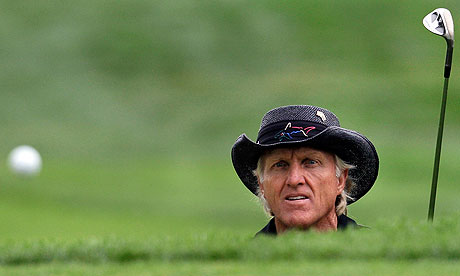

Norman moved a lot of earth -– 900,000 cubic meters, reportedly –- to build the Wave’s 7,300-yard Al Mouj track, but he believes the results will soon speak for themselves. Until that day comes, however, he’ll do the talking. During a site visit in July, the Florida-based “signature” architect called the links-inspired, soon-to-be floodlit layout “one of the finest golf courses I have ever produced anywhere in the world” and one that will be “worthy of hosting a prestigious world-class tournament, perhaps a European Tour event, in the near future.”

Thanks to such comments, the club’s general manager told the Times of Oman, “we are well on the way to establishing the AlMouj golf course as a top golfing destination in the Gulf.”

Speaking of vacation destinations, I should note that Oman reportedly lured more than 1 million tourists last year, a 12 percent increase over the number recorded in 2009. The Times notes that the emirate has emerged as an attractive vacation spot in part because of the Arab Spring, which has turned Egypt, Libya, Syria, and other Middle Eastern nations into no-go zones.

Some information in this post originally appeared in the December 2011 issue of the World Edition of the Golf Course Report.

And in Other News . . .

. . . india Ground is being cleared for the first golf course in Surat, the capital of the state of Gujarat. The as-yet unnamed 18-hole track will be the featured attraction of a 300-acre community that’s been master-planned to include houses and a sports center. “Our idea is to develop a facility that will cater not only to golf lovers but also to families during the weekends,” says Manish Katargamwala of Shree Hari Corporation, which plans to break ground on the community’s clubhouse in early 2012. Incidentally, Wikipedia identifies Surat as “the third-cleanest city in India.”

. . . ireland A pair of 18-hole golf courses may soon emerge on the site of the Battle of the Boyne in County Louth. The battle, which claimed the lives of an estimated 1,500 Protestants and Catholics, was fought in 1690, on what is now the home of Oldbridge House. The house and its accompanying 550 acres, located in a northern suburb of Dublin, were recently purchased by what the Drogheda Independent describes as “a consortium of national and international businessmen.” The new owners aim to flank the golf courses with a resort-style hotel, some golf and fishing lodges, and an equestrian center. This appears to be an upgrade for the Oldbridge estate, which in recent years had been owned by a fellow identified as a “pig farmer” and was presumably operated as a pig farm.

. . . china Two noteworthy tidbits from the recent China Golf Show in Guangzhou, the city once known as Canton: First, Golf Course Architecture reports that the show had “a smaller representation of golf architects than in previous years.” Do you think that’s a sign of the times, or a harbinger of things to come? Second, the largest group of exhibitors at the event were said to be companies selling golf simulators, a video-game version of golf. John Strawn, the president of Hills & Forrest International Golf Course Architects, takes a benign view of artificial golf’s growing popularity, describing the simulators as “the low-cost entry point for people yearning to play golf -- what they can play until China takes on building daily-fee courses or even municipal courses.” My question: What if China’s 20- and 30-somethings get hooked on video-game golf and conclude that actual golf -- with venues that aren’t nearly so visually appealing and weather that isn’t nearly so ideal -- isn’t nearly as much fun?

. . . abu dhabi Now that Golf Digest has named Yas Links as the best golf course in the Middle East, tourism officials in Abu Dhabi are furiously touting their golf offerings. These days Abu Dhabi boasts three of the best courses in the region, they argue: Yas Links at number one, Abu Dhabi Golf Club at number three, and Saadiyat Beach Golf Club at number six. “These vital recognitions highlight the significant progress Abu Dhabi has made as a world-class golf tourism destination,” claims a tourism official. Really? Not to dis any of the aforementioned courses, but we need to put Golf’s rankings in perspective. According to my best count, there are only about 16 or 17 golf courses in the seven United Arab Emirates, just five of them in Abu Dhabi. The emirate’s tourism boosters can stretch the facts any way they want, but the plain truth is that their golf courses are the proverbial big fish in a very small pond.

. . . united states The Point has been Trumped. Donald Trump, who’s still threatening to become a presidential candidate, has decided that he no longer wishes to buy the Point Lake & Golf Club, a property viewed by his son as having “a lot of potential.” The Trump Organization’s interest in the Point, which is located on Lake Norman in Mooresville, North Carolina, was mentioned in this blog just last week. Eric Trump blames the end of the dream on “a lack of direction” at the club – the ability to identify poor leadership is apparently a family trait -- explaining that his family doesn’t wish “to get bogged down with a deal that has a lot of different parties all moving in different directions.” Unfortunately, democracies are like that.

wild card click No risk, no reward.

Friday, December 9, 2011

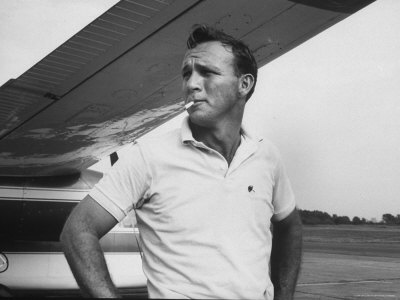
worth reading Arnold Palmer, Now and Forever

Can Arnold Palmer live forever?

The King’s company, Arnold Palmer Enterprises, is doing its best to ensure that he does. Not as a golfer or golf course designer, to be sure -- those days are already gone -- but as a salesman whose pitch can resonate with people who never once saw him smack a Titleist.

Palmer has long been golf’s premier salesman. And now his handlers are developing new marketing programs that will enable him to continue hawking clothes, tea-based drinks, motor oil, and who knows what else long after he sinks his final putt. Men may die, but brands endure.

Advertising Age has given us a preview of Palmer’s next life and the people who are in charge of it. My question: Do these marketing efforts enhance Palmer’s legend or diminish it?

Arnold Palmer did not invent sports marketing. But he nearly perfected it, amassing a global empire of licensing deals and endorsements that seems just as relevant today as it was when he first began building it back in the 1950s.

Now the 82-year-old golfing legend is out to make sure his dynasty outlasts him.

Arnold Palmer Enterprises, which houses marketing ventures from wine to sunscreen, is in the midst of a branding review with the aim of reaching a generation of fans who weren’t even born when he was racking up tour wins.

“We’re at a crucial point in Mr. Palmer’s career,” said Cori Britt, vice president of Arnold Palmer Enterprises. “We're looking forward to ensuring the Arnold Palmer brand is positioned for success 20, 30, 40, 50 years from now.”


As it looks to the future, the group is culling nonstrategic licenses while seeking out new ones that dig deeper into Mr. Palmer’s past, evoking a 1960s-era younger, stronger Arnie in hopes of capitalizing on the retro fever captured by the likes of the hit TV show “Mad Men.” Among the projects in the pipeline are a new clothing line featuring styles Mr. Palmer wore decades ago that seek to recapture the spirit that this year vaulted him onto
GQ magazine's list of “The 25 Coolest Athletes of All Time.” . . .

And he remains a gold mine even at a golden age. Mr. Palmer, who retired from competitive golf in 2006, had $36 million in earnings last year, ranking him No. 3 on
Golf Digest’s “all-encompassing money list,” which includes on-course and off-course revenue such as endorsement and licensing fees. He was superseded by only two active players: Tiger Woods and Phil Mickelson.

“The fact that he's still earning $36 million a year is a real testament to the power of his brand,” said Jim Andrews, senior vice president at IEG, a sponsorship, research, and consulting firm.

Indeed, Mr. Palmer’s appeal, as measured by the Marketing Arm’s Davie Brown Index -- which quantifies influence, awareness, and other celebrity attributes -- is more than double that of Luke Donald, today’s No. 1 PGA Tour player, according to the Golfweek/Sagarin Performance Index. . . .

[Mr. Palmer’s] classic cool look will be showcased in a retro clothing line called Arnie, set to launch in February. Three upscale collections will feature styles he wore in the 50s (small collars and short plackets), 60s (wider-legged pants and collars), and 70s (more subdued colors). . . .

Mr. Palmer is also growing his partnership with Arizona Beverages, which is expanding distribution of its recently launched Arnold Palmer Hard Half & Half, a spiked version of the lemonade-tea mixture the golfer made famous long ago. Arizona, which markets Hard though affiliate Hornell Brewing Company, plans to grow distribution to 21 states from five, following the success of the 10-year-old nonalcoholic Half & Half, which has developed a strong base of young consumers.

“His status as `The King’ gives him a charisma that is hard for a young demographic to resist, even if they have never seen him play professionally,” said Arizona spokeswoman Jackie Harrigan. . . .

Mr. Palmer’s marketing machine first gained steam in 1960, when he paired with agent Mark McCormack, who went on to found legendary sports agency IMG. (Mr. McCormack died in 2003, but Mr. Palmer remains with IMG.)

“A brilliant part of Mark’s marketing strategy was never to tie my endorsement of a product to how I was faring on the golf course,” Mr. Palmer says on his website. “His aim was never to position me as a `winner’ because there always comes a day when a winner no longer wins.”

Rather, the strategy touted Mr. Palmer’s endurance, reliability, and integrity. And years later, Mr. Palmer is still finding marketing success based on that philosophy -- along with lucking into the fact that the 60s are in. . . .

Wednesday, December 7, 2011

argentina Don’t Cry for Jack Nicklaus

These days the associates at Jack Nicklaus’ design firm are spending plenty of time in Argentina, where they have two active projects.

Under construction is a 27-hole complex planned to be the centerpiece of Valle del Golf, an 875-acre community in suburban Cordoba, the nation’s second-largest city. Valle del Golf, which will include 1,685 houses, is being developed by ECIPSA Group, a firm led by Jaime Garbarsky. The first nine of the golf complex, created by North Palm Beach, Florida-based Nicklaus Design, has been grassed, and the second nine is under construction.

In addition, next year construction is expected to begin on an 18-hole Jack Nicklaus Legacy course -– a course to be co-designed by Nicklaus and his son Jack -– at a wine-focused community in Mendoza. The as-yet unnamed community (the working title is Malbec Village) is expected to include houses and vineyards, along with wine-making facilities.

The wines being produced in greater Mendoza, the largest wine-producing region of Latin America, are said to be on a par with those coming from Napa Valley, Tuscany, and Bordeaux.

Sunday, December 4, 2011

The Week That Was, december 4, 2011

iceland No Go for Huang Nubo

Authorities in Reykjavik, a city not mentioned nearly enough in this blog, have squelched a wealthy Chinese entrepreneur’s plan to build a golf resort in a remote part of northeastern Iceland.

Huang Nubo, the chairman of Beijing-based Zhongkun Investment Group, Ltd., had hoped to build what’s been described as “an eco-tourism resort” on 74,130 acres near Myvatn Lake and the town of Holssel. Huang, one of China’s richest people (Forbes estimates that he’s worth $890 million), had agreed to pay $8.8 million for the property, on which he planned to build a hotel, an air strip, unspecified sports facilities, and an 18-hole golf course.


The proposal caused considerable distress in Iceland, due mainly to fears about why Huang, who has ties to China’s communist party, needed to buy 0.3 percent of Iceland’s total land mass for a hotel and a golf course.

The sale was blocked, according to Iceland’s interior ministry, because it didn’t meet several legal requirements, in particular one stipulating that purchasers of Icelandic property be Icelandic citizens or permanent residents of Iceland for at least five years.

The decision must have come as a surprise to Huang, seeing as how Iceland’s economic affairs ministry supported the sale.

“The ministry of economic affairs sees no reason to believe that Iceland's interests are in any way threatened by the foreign investment in question,” the economic affairs minister said just days before the final decision was announced.

Maybe that’s why Huang was so ticked off when he got the news.

“If I had known that we were not qualified,” he griped to the Global Times, “I wouldn't have wasted so much time and money on the case.”

He’ll get over it. He has plenty of other irons in the fire.

Huang began his career as a government bureaucrat, in China’s Central Propaganda Department and in its Ministry of Construction. He left public service to create Zhongkun, which is in the business of developing resort-related real estate. Its motto is “let’s do more for society.”

Zhongkun has a global perspective and far-reaching ambitions. In 2006, it opened a golf course in China’s Xinjiang Province, Kashi Zhongkun International Golf Course in Kashi City, and since then its portfolio has grown to include various resort and tourist facilities elsewhere in the People’s Republic. Its most enterprising subsidiary appears to be Hawthorn Vacation Club, which aims to create a network of vacation destinations in Asia, Europe, and the United States. These properties, to be developed over the next decade, include “holiday villages,” a “wine manor,” organic farms, and a bunch of golf courses.

But Huang doesn’t think of himself primarily as a businessman or a developer. He prefers to think of himself as a poet (he’s published several books of poetry) and as an adventurer, in particular a mountain climber. Since 2005, he’s climbed seven of the most challenging peaks on seven continents -- including Mount Everest, Mount McKinley, and Mount Kilimanjaro -- and he’s set foot on both the North and the South poles.

Huang’s visit to the North Pole took place earlier this year. He made it with a group that included one of his long-time Icelandic friends and, perhaps not coincidentally, an Icelandic diplomat who’s stationed in Beijing. Such expeditions, I’m sure you’ll agree, are a nice way to renew old friendships and cement new ones.

Huang hasn’t said whether he’ll appeal the government’s ruling or whether he’ll try to circumvent it in some way. But he clearly believes that Iceland isn’t receptive to Chinese investment.

“The rejection sent a message to Chinese investors that you are welcome to emigrate or to buy properties and luxury goods,” he told the Global Times, “but if you want to engage in anything related with natural resources, you're not welcome.”

Some information in this post originally appeared in the September 2011 issue of the World Edition of the Golf Course Report.

And in Other News . . .

. . . brazil The organizers of Brazil's Olympic games have whittled the golf course design competition to an Elite Eight. Half of the finalists are tried-and-true U.S. architects: Jack Nicklaus (with Annika Sorenstam), Greg Norman (with Lorena Ochoa), Gary Player, and Robert Trent Jones, Jr. There are two international contestants -- Martin Hawtree of England and Peter Thomson (with Ross Perrett) of Australia -- and the committee made two surprise selections: Tom Doak and Gil Hanse. Will there be room for a dark horse on the podium? The winner of the $300,000 commission will be named next month.

. . . united states When he isn’t preparing to host a presidential debate, Donald Trump continues to sniff out undervalued golf properties. The New York-based golf developer has renewed his previous interest in the Point Lake & Golf Club, the centerpiece of a faux-Nantucket community on Lake Norman in Mooresville, North Carolina. The club features a 12-year-old, Greg Norman-designed course that one of Trump’s sons believes “has a lot of potential” and “could be really special” if the family spiffs it up. The talk in the tony, 1,200-acre community is that Trump will submit a formal proposal in February.

. . . china Lee Schmidt and Brian Curley will soon complete work on another golf property on Hainan Island, a place they must by now know like the back of their hands. Since the spring of 2010, the Scottsdale, Arizona-based duo has been overseeing a makeover of Nanlihu International Golf Club, which features a 27-hole complex designed by Wang Zong Qian, a Taiwanese architect. Flagstick Golf Course Construction Management reports that the complex “is shaping up to be one of Hainan Island’s premier golf destinations,” though it can’t possibly out-draw the 10-course (and counting) complex that Schmidt and Curley designed at the massive Mission Hills resort.

. . . united states The discontented 99 percent won’t be focused exclusively on Wall Street anymore. Club & Resort Business reports that the Occupy L.A. protesters, recently scattered from a park near city hall, have vowed to make their presence felt “at locations such as banks, homes of bank executives, or golf courses and country clubs.”

. . . wild card click You have nothing to fear but fear itself.

Friday, December 2, 2011

worth reading A Rose by any Other Name . . .

I’ve waited way too long to blow a kiss to John Paul Newport of the Wall Street Journal, who several months ago went on an extended riff about golf course names and what he calls “the imaginative power of those who dream up the names.”

Here are some highlights:

The bird is the word. There are, to be precise, 149 U.S. golf courses with eagle in the name, according to a count of nearly 13,000 golf facilities by the National Golf Foundation. They range from the Soaring Eagles Golf Course in Horseheads, New York to the somewhat less inspiringly named Spread Eagle Golf Course in Spread Eagle, Wisconsin. There is an Eagle Point golf course in Oregon and an Eagle Pointe in Indiana. The difference, primarily of interest to marketers, is approximately the same as between shop and shoppe. . . .

Deer in the headlights. The word deer is a convenient naming device because deer are ubiquitous, to the point of actually being a nuisance in many regions, thanks to a fall-off in natural predators. Yet deer still connote woodland innocence. Thus real-estate developers, the primary source of new golf courses for at least the last 40 years, retain plausible credibility when they transform previously featureless tracts of land into golf nirvanas with names such as Deer Park, Deer Creek, Deer Meadow, Deer Run, Deer Ridge, and Deer Trace, not to mention Doe Valley and Fawn Crest. . . .

As times go by. Golf course names, if not the courses themselves, provide a fair gloss on American history. You could start at Plymouth Country Club in Massachusetts and continue to Patriot Hills Golf Club and Rip Van Winkle Country Club in New York. Then, Peace Pipe Country Club in New Jersey, Pocahontas Golf Course in Iowa, the Links at Davy Crockett in Tennessee, Little Bighorn Golf Club in Indiana, Westward Ho Country Club in South Dakota, Oregon Trail Country Club in Idaho, Conestoga Golf Club in Nevada, and, finally, Settlers Bay Golf Course in Wasilla, Alaska (Sarah Palin's town). . . .

The soul of the game. Far too many course names sound like they were lifted from children's books: Candywood, Melody Valley, Happy Hollow, Sunny Meadows, Sugar Isle, Songbird Hills, Kissing Camels, Growling Frog. Luckily, these are countered by a slate of names that seem to get golf's personality just about right: Chagrin Valley, Crab Meadow, Bogey Hills, Grindstone Neck, Murder Rock, Nutters Crossing, Ruffled Feathers, Sourwood Forest, and the Creek at Hard Labor. . . .

The wrong side of the law. To create buzz, developers are using macho names like Horse Thief Country Club in Tehachapi, California, Renegade Golf Course in Wyoming, the Bandit in Texas, the Hombre in Florida, the Devil's Claw in Arizona, and Thunder Canyon -- one each in Idaho and Nevada. . . .

Dark shadows. House Speaker John Boehner was recently caught on an open mic describing his two-under-par round at a remote high-end course in Nebraska called Dismal River. There are a surprising number of similarly dour course names: Stoney Links, Stumpy Lake, Reedy Creek, Useless Bay, Potholes, Charwood, Rainsville, Furnace Creek, and the Pit Golf Links, much less Mold Golf Club in Wales. Maybe the owners are just doing the best with what they have. . . .